Why read this: "Digital Self-Defense Before It's Too Late"
AI has turned cybercrime into something almost undetectable: flawless phishing emails, perfect voice clones, and deepfake videos that can fool even careful people in seconds. This article shows exactly how criminals weaponize the same tools we use every day, and why strong passwords alone are no longer enough. You’ll discover practical ways to sharpen your judgment, spot urgency traps, and even turn AI into your own defensive ally without sacrificing privacy. Read it now, before the next convincing message arrives and it’s too late to pause.
Less than a decade ago, cybercriminals were often easy to spot. Phishing emails were riddled with spelling errors, fake websites looked amateurish, and fraudulent phone calls were usually transparent attempts to swindle people out of money. Those days are gone. Thanks to artificial intelligence, criminals now have access to the same advanced technology used by major corporations and governments. Consequently, digital self-defense has become more important than ever.
AI is transforming the world at breakneck speed. We use intelligent systems to write text, create images, develop software, and solve complex problems. In hospitals, AI assists doctors with diagnoses, companies automate their customer service, and scientists use the technology to develop new medicines. The possibilities seem endless. Yet, as with any technological revolution, this development has a downside.
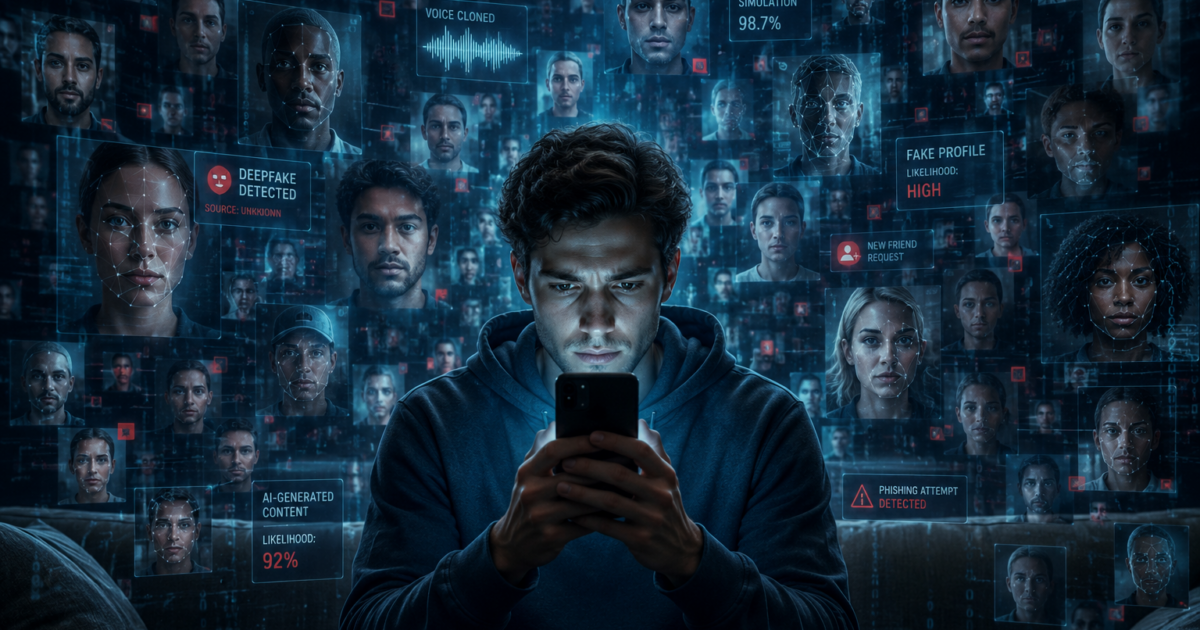
Cybercriminals have discovered that AI makes their work faster, cheaper, and more convincing. Phishing emails no longer need to be written by a human, an AI system can draft a flawless, credible email in seconds that perfectly mimics the style of a bank, government agency, or employer. The days when suspicious messages could be easily identified by awkward phrasing are over. Today, the most convincing messages are often the most dangerous.
Our voices, too, are no longer a reliable form of identification. With just a few seconds of recorded audio, an AI system can replicate a voice almost perfectly. This means someone could receive a call from a person sounding exactly like a family member, colleague, or supervisor, when in reality, the voice is entirely artificially generated. The same applies to video. Thanks to deepfake technology, faces and voices can be replicated so realistically that distinguishing the genuine from the fake is becoming increasingly difficult. These developments mean that digital self-defense is no longer just about technology. While strong passwords, software updates, and two-factor authentication remain important, the primary line of defense lies not in our computers, but in our own judgment. In a world where images, voices, and text can be effortlessly faked, critical thinking is becoming perhaps the most important digital skill.
We will increasingly need to ask ourselves whether a message truly originates from the sender it claims to be. A convincing email is no proof of authenticity, and a familiar voice on the phone is no longer a guarantee. Digital resilience means learning to pause before acting. Messages that create a sense of urgency or stir up strong emotions deserve particular scrutiny. Cybercriminals know that people are more prone to making mistakes under time pressure, and they deliberately exploit this.
Ironically, AI can also help us protect ourselves better. Modern security systems use artificial intelligence to detect anomalous behavior, block suspicious login attempts, and identify new forms of malware faster than traditional software ever could. AI can also be a valuable assistant for individual users. An AI chatbot can help analyze suspicious messages, explain complex privacy policies in plain language, or offer advice on digital safety. Thus, the very technology that empowers cybercriminals can also become a vital tool for defense.
However, this requires prudent use. Many people share sensitive information with AI systems without a second thought. They upload confidential documents, corporate data, or personal information to get answers more quickly, often forgetting that not all AI services handle data in the same way. Digital self-defense therefore also means consciously considering what information you share and what you do not. Convenience should never take precedence over privacy.
Beyond the immediate security risks, AI is also changing the way we consume information. Social media platforms use sophisticated algorithms to predict exactly which posts will capture our attention. News, advertisements, and videos are increasingly tailored to our specific interests and emotions. This makes the digital world comfortable, yet also vulnerable. When AI determines the information we see, there is a risk that we might unknowingly end up in an information bubble where dissenting opinions are barely visible. Digital self-defense therefore also entails actively seeking out diverse sources and being willing to critically examine our own beliefs.
We are only at the beginning of the AI revolution. Virtual assistants are becoming increasingly intelligent, robots will play a greater role in our daily lives, and the boundary between human and machine will increasingly blur. The coming years will see the emergence of new applications that we can scarcely imagine today. This offers unprecedented opportunities for innovation, science, and personal development, yet simultaneously demands new skills.
Consequently, digital self-defense has evolved into far more than just a collection of technical tips, it is a mindset. It means understanding how artificial intelligence works, engaging critically with digital information, and making conscious choices regarding our privacy and security, not out of fear of technology, but precisely so we can use it with confidence.
History shows that every technological revolution brings new challenges. The invention of the printing press transformed the dissemination of knowledge, the internet interconnected the world, and artificial intelligence will once again fundamentally change the way we work, communicate, and make decisions. The question, therefore, is not whether AI will influence our lives, but how well prepared we are for that future.
In the era of artificial intelligence, digital self-defense is no longer a choice. It has become an essential skill for anyone wishing to participate safely, independently, and confidently in the digital society.
About Dirk Jan Buter
I am a software developer, programmer, and the founder of Yvonta, based in Zwolle, The Netherlands. With a deep passion for low-level systems, custom software architecture, and the evolving intersection of AI and human digital persistence, I spend my time building specialized tools and exploring the technical and philosophical boundaries of digital autonomy.
Writing and publishing are central to my work, but navigating them comes with a unique challenge: I live with dyslexia. To bridge the gap between complex architectural ideas and clear communication, I use AI as an active co-writer and editorial partner. This collaboration allows me to focus fully on the core concepts, logic, and perspective of my writing, ensuring my technical insights and independent editorial projects are shared with clarity and precision.
Frequently Asked Questions
16 questions
Less than a decade ago, phishing emails often contained spelling errors and looked amateurish, making them easy to spot. Today, AI allows criminals to generate flawless, credible emails in seconds that perfectly mimic the style of banks, government agencies, or employers. This shift means suspicious messages can no longer be identified by awkward phrasing, and the most convincing messages are often the most dangerous.
With just a few seconds of recorded audio, AI can replicate a voice almost perfectly, enabling calls that sound exactly like family members, colleagues, or supervisors. This technology removes voices as a reliable form of identification since the voice is entirely artificially generated. People must now question whether a familiar voice on the phone truly belongs to the claimed sender.
Deepfake technology can replicate faces and voices so realistically that distinguishing genuine video from fake is increasingly difficult. This development erodes trust in video content for authentication or communication. As a result, digital self-defense requires skepticism toward any video that could influence decisions or emotions.
While strong passwords, updates, and two-factor authentication remain important, AI makes faking text, voices, and images effortless, shifting the main defense to human judgment. Users must pause and verify whether messages truly originate from the claimed sender, especially those creating urgency or strong emotions. Cybercriminals exploit emotional responses and time pressure to induce mistakes.
Modern security systems use AI to detect anomalous behavior, block suspicious logins, and identify new malware faster than traditional methods. Individual users can employ AI chatbots to analyze suspicious messages, simplify privacy policies, or provide digital safety advice. This dual role means the same technology empowering criminals can also strengthen defenses when used prudently.
Users often upload confidential documents or personal data to AI tools without considering how services handle that information. Digital self-defense requires consciously evaluating what data to share, as convenience should never override privacy. Not all AI platforms manage data equally, so selective sharing helps mitigate risks.
Algorithms predict and tailor posts, news, and videos to individual interests and emotions, creating personalized but narrow feeds. This comfort comes at the cost of reduced exposure to dissenting views, making users vulnerable to one-sided information. Digital self-defense involves actively seeking diverse sources and critically examining personal beliefs.
Digital self-defense has evolved beyond technical tips into a mindset of understanding AI, engaging critically with information, and making conscious privacy choices. It emphasizes using technology confidently rather than fearing it, while preparing for blurred human-machine boundaries. This approach enables safe participation in the digital society amid rapid AI advancement.
The article draws parallels to the printing press transforming knowledge dissemination and the internet interconnecting the world. Like those shifts, AI will fundamentally change work, communication, and decision-making. The key question is how well prepared individuals are for these changes rather than whether they will occur.
AI is advancing at breakneck speed with applications in medicine, customer service, and creative fields, yet it simultaneously empowers cybercriminals with sophisticated tools. Without proactive defense, individuals risk falling victim to convincing fakes or information manipulation. The article concludes it is no longer a choice but a requirement for safe, independent digital participation.
Criminals deliberately create messages that induce urgency or strong emotions because people are more likely to err under time pressure. AI enables rapid generation of such tailored, convincing content. Scrutinizing these emotional triggers is a core part of critical thinking in digital self-defense.
Technology like passwords and updates is still useful but secondary to judgment since AI fakes content effortlessly. The focus now lies in pausing before action and verifying authenticity of text, audio, or video. AI tools themselves can assist in analysis when users apply them carefully.
Many assume a convincing email, familiar voice, or realistic video proves authenticity, but AI renders these unreliable. The article stresses that no such element guarantees legitimacy anymore. This misconception leaves people vulnerable without updated critical evaluation habits.
Virtual assistants will grow more intelligent, robots will integrate further into daily life, and boundaries between human and machine will blur. New applications beyond current imagination will emerge, bringing both opportunities and demands for new skills. Preparation through critical engagement with AI is essential.
Users should deliberately seek out diverse information sources and remain willing to challenge their own beliefs. Relying solely on personalized feeds risks missing alternative perspectives. This proactive approach forms part of broader digital resilience.
The primary recommendation is to pause before acting, especially with messages creating urgency or emotional reactions. Users should question the sender's true identity rather than assuming authenticity based on style or familiarity. AI chatbots can further assist in analyzing such messages for added protection.
Generated by AI to give you complete answers about this topic.

Leave a Reply