Why read this: "The Ideal Balance"
What happens when one partner’s mind explodes with endless “what ifs” while the other’s precision funnel turns chaos into clear action? This article reveals how divergent and convergent thinking, often seen as opposites, create both fiery clashes and unstoppable creative synergy in a real marriage. Through Dirk Jan and Puja’s raw, everyday story, you’ll discover practical ways to bridge the gap between dreamers and doers so neither style gets crushed. Read it to unlock the ideal balance that turns friction into the exact partnership most couples and teams are missing.
You know the feeling: one person dreams in a thousand directions at once, while the other is already standing ready with a calculator and a planner. In the world of human thought, there is a fascinating tension between two types: the people who spread out and the people who focus. In psychology, they call this divergent and convergent thinking. Although these are often seen as opposites, the real magic happens right in the middle. For my wife Puja and me, Dirk Jan, this is not a dusty theory from a textbook, but simply our daily reality. It is the heartbeat of our marriage and our shared creative life.
To understand why we work together so well, and why we sometimes have blazing rows, you have to take a look under the hood of our brains. My brain works like a sort of expanding web or an exploding star. I am a born divergent thinker. That means that a single idea never stays alone with me for long; it immediately explodes in a dozen different directions. For me, a problem is never just a wall I have to climb over, but rather a gateway to a thousand “what if” scenarios, all of which are worth investigating.
Puja operates on a completely different frequency. Her brain functions like a precision funnel. She is a master at filtering a huge mountain of chaotic information until she arrives at the most logical, efficient, and correct path. This convergent thinking is truly an art form: the art of integration and execution. She finds happiness in structure, picking up speed, and the satisfaction of a definitive answer. While I am still standing somewhere on the horizon gazing at new possibilities, she has already calculated the exact coordinates of our current position.
That life as a divergent-convergent duo can sometimes feel like a collision between a cloud and a mountain. Our greatest struggle lies in the tension between what I call the “infinite loop” and what Puja sees as the “end bell.” Imagine this: I come home with a wild idea for a new project or a change in our house. I am driven by the sheer energy of what is possible, and I want to talk about every conceivable version of that new reality. For Puja, that is deadly exhausting. Her mind immediately starts calculating the budget, the schedule, and the practical snags. While I am still enthusiastically opening new doors, she is already forcefully slamming shut the doors that lead nowhere.
Fortunately, we have noticed that you can bridge this gap simply by setting boundaries for our conversations. Before we dive into a brainstorming session, I now check in with her: “Do you have the mental space and the energy right now to think creatively with me without limits?” We often set a time limit so that neither of us feels overwhelmed. And if Puja wants to make a decision, she lets me know in advance. Then I know I need to switch my brain from ‘exploration mode’ to ‘focus mode’. That simple check-in ensures that our conversations remain respectful and that both thinking styles get room to breathe. This difference is also reflected in how we define chaos. To me, a structure that is too rigid feels like a cage that hinders my growth. For Puja, a lack of structure feels like a lack of security. When we plan a vacation, my ideal scenario is an empty schedule so we can follow our intuition. For her, that is an absolute nightmare. The “freedom” I crave so much, she views as a disorganized waste of time and precious energy. Without a destination and a clear plan, she simply cannot relax.
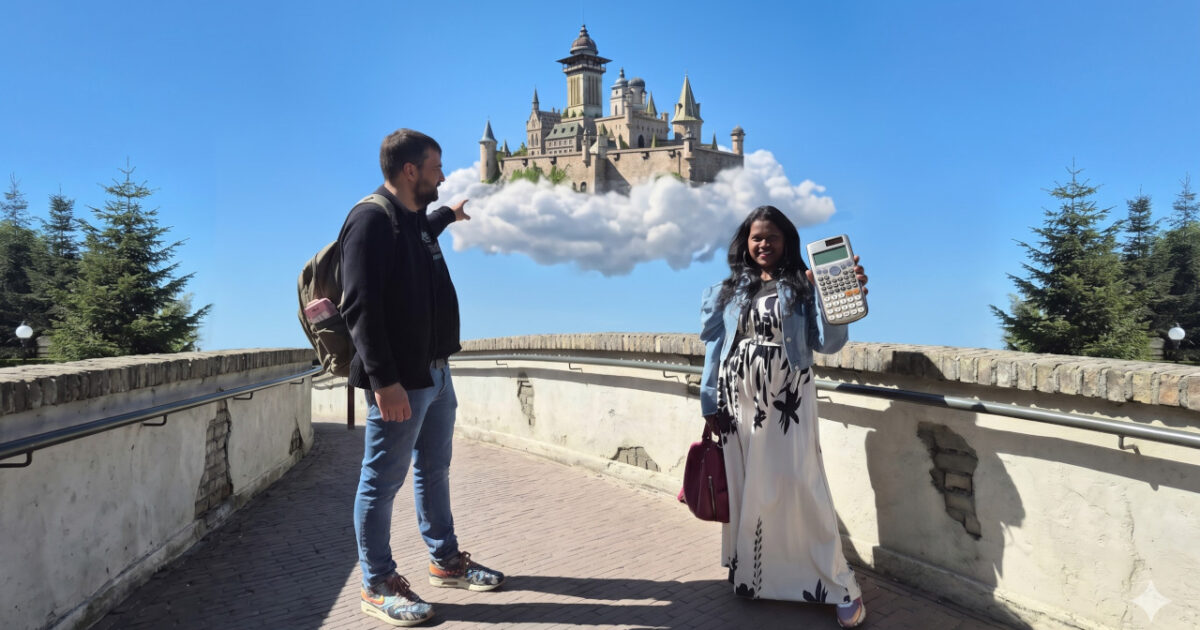
Yet, these frictions are precisely the reason why we are such a good team. We have found an ideal balance where my imagination and her execution power come together in something we could never have achieved alone. A divergent thinker without a convergent partner often gets stuck in dreams and never finishes anything. I can come up with a hundred brilliant plans, but without Puja, they remain sketches on a beer mat. She is the backbone of my creativity; she transforms my “what ifs” into a tangible “here it is.” She is the architect who ensures that my castles in the air actually get a foundation on the ground.
At the same time, without that divergent stimulus, a convergent thinker can easily get stuck in the trap of routine. When Puja feels trapped in a problem that seems unsolvable, I am the one who pulls her out of that tunnel vision. I point her towards paths she would never have thought of herself. I give her the oxygen needed not only to do things right, but also to ensure that we are doing the right things.
Ultimately, Puja acts as the perfect filter for my chaotic mind. She helps me to throw the most impractical ideas overboard, so that we can use our energy I invest in the few plans that are truly life-changing. In return, I help her realize that the “right” path is not always the only way, and that a side road often leads us to much more colorful and joyful experiences than a spreadsheet could ever predict. We don’t have to become the same; we must respect each other’s roles. I bring the growth, she brings the focus.
If you recognize this in your own relationship, take a good look at your own patterns. Are you the dreamer who shoots off in all directions, or the one holding the funnel? By talking honestly about these differences, you turn that daily friction into the fuel you need to grow together.
About Dirk Jan Buter
I am a software developer, programmer, and the founder of Yvonta, based in Zwolle, The Netherlands. With a deep passion for low-level systems, custom software architecture, and the evolving intersection of AI and human digital persistence, I spend my time building specialized tools and exploring the technical and philosophical boundaries of digital autonomy.
Writing and publishing are central to my work, but navigating them comes with a unique challenge: I live with dyslexia. To bridge the gap between complex architectural ideas and clear communication, I use AI as an active co-writer and editorial partner. This collaboration allows me to focus fully on the core concepts, logic, and perspective of my writing, ensuring my technical insights and independent editorial projects are shared with clarity and precision.
Frequently Asked Questions
16 questions
Divergent thinking involves a single idea exploding into many different directions and possibilities. The author describes it as his brain working like an expanding web or exploding star, where problems become gateways to numerous 'what if' scenarios. This style thrives on exploration without immediate limits.
Convergent thinking is the ability to filter large amounts of chaotic information down to the most logical, efficient, and correct path. Puja exemplifies this with her brain functioning like a precision funnel that integrates and executes ideas. It brings structure, speed, and definitive answers to problems.
The author identifies as a born divergent thinker whose ideas never stay alone but immediately branch into dozens of directions. He views problems as opportunities for investigation rather than obstacles to overcome. This leads him to generate many possibilities before settling on any one.
Puja operates as a convergent thinker who calculates budgets, schedules, and practical issues immediately upon hearing an idea. While the author explores new horizons, she determines exact coordinates and closes unworkable paths. Her approach emphasizes structure and the satisfaction of reaching a clear conclusion.
The tension arises between the author's 'infinite loop' of exploring possibilities and Puja's 'end bell' that signals the need for closure and decisions. This can feel like a collision between a cloud and a mountain during conversations. Their differing definitions of chaos further fuel friction, with rigid structure feeling like a cage to him and lack of structure feeling insecure to her.
They use a check-in system where the author asks if Puja has mental space and energy for unlimited creative thinking. They often set time limits to prevent overwhelm, and Puja signals in advance when she needs focused decision-making mode. This ensures both styles receive respect and breathing room.
The author prefers an empty schedule to follow intuition and embrace freedom during vacations. Puja sees this as a disorganized waste of time and energy that prevents relaxation. She requires a destination and clear plan to feel secure and enjoy the trip.
Puja acts as the backbone by transforming the author's sketches and 'what ifs' into tangible results through execution. She filters out impractical ideas so energy focuses on life-changing plans. Without her, his hundred brilliant plans would remain unfinished.
The author pulls Puja out of tunnel vision by pointing to unexpected paths she would not consider alone. He provides oxygen to ensure they do the right things rather than just doing things right. This divergent stimulus prevents her from becoming trapped in solvable problems.
The balance combines the author's imagination and growth with Puja's focus and execution power. Together they accomplish what neither could alone, turning friction into fuel for growth. The author brings possibilities while Puja provides the foundation to realize them.
Readers should honestly examine whether they are the dreamer shooting in all directions or the one holding the funnel. By discussing differences openly, daily friction becomes fuel for mutual growth. Respecting each other's roles without trying to become the same person is key.
They appear opposite because one spreads out into possibilities while the other narrows down to solutions. Yet the article argues the real magic occurs in their combination rather than in isolation. The author and Puja demonstrate this daily in their marriage and creative work.
Divergent thinkers often get stuck in dreams and never finish projects without convergent support. The author notes he can generate many plans but they remain sketches without Puja's execution. This highlights why balance prevents unfulfilled potential.
The author helps Puja see that the 'right' path is not always the only way and that side roads can lead to more colorful experiences. A spreadsheet cannot predict the joy these detours bring. This challenges pure convergent focus with divergent flexibility.
The article challenges the view that divergent and convergent thinking must remain in conflict or that one person must adopt the other's style. Instead, respecting distinct roles allows complementary strengths to create better outcomes. Friction becomes productive when boundaries are set.
The concepts are presented as fundamental types in human thought and psychology, not limited to the author's marriage. They apply to creative partnerships where one provides expansion and the other integration. The couple's experience serves as a model for turning natural tensions into collaborative advantages.
Generated by AI to give you complete answers about this topic.
* **Services:** AI clones (voice/video), real-time 3D avatar implementation, custom software development, the Yvonta News Platform, and **trade**.
* **Input Data:** Audio, video, or images provided by the client for AI processing.
#### 2. Delivery and acceptance of the service
* **2.1. Best effort:** AI services, the Yvonta News Platform, and trade services are provided on a "best effort" basis. Technical artifacts, minor deviations in likeness, fluctuations in automated content aggregation, or market data latency are inherent to the technology and do not constitute a defect.
* **2.2. Acceptance period:** Custom software and 3D models are deemed accepted if the client does not report specific bugs in writing within 7 days of delivery.
* **2.3. Third-party dependency:** Yvonta frequently utilizes third-party API providers (e.g., AI engines, cloud hosting, news feeds, financial exchange data). Yvonta is not liable for service interruptions, execution failures, or data accuracy issues caused by these third parties.
#### 3. Intellectual property & ethical use
* **3.1. Ownership:** Yvonta retains all rights to its proprietary code, training methods, and base 3D models. The client receives a license for the final result.
* **3.2. Right of likeness:** The client guarantees that they possess the rights to the voice/face being cloned. Yvonta is not obliged to verify these rights but may request proof.
* **3.3. Termination due to misuse:** Yvonta reserves the right to terminate any agreement immediately and without refund if the client uses the services for:
* Generating deepfakes without consent.
* Illegal, hateful, or pornographic content.
* Impersonation for fraudulent purposes.
* Spreading verified misinformation or unauthorized scraping via the News Platform.
* **3.4. Compliance Responsibility:** The Client warrants that their use of the Yvonta News Platform and trade services complies with applicable media laws, financial regulations, copyright regulations, and privacy rules (e.g., GDPR).
#### 4. Liability (The "Shield" clauses)
* **4.1. Financial limit:** Yvonta’s total liability is strictly limited to the amount paid by the Client for the relevant project.
* **4.2. No indirect damages:** Yvonta is in no event liable for loss of profit, loss of data, or consequential damages (e.g., if the Client’s client cancels a contract due to a bug in Yvonta’s software, a failure in the News Platform feed, or financial losses incurred through trade).
* **4.3. Indemnification:** The Client indemnifies Yvonta against all legal costs and damages arising from third-party claims regarding the Input Data, the content published via the News Platform, financial activities conducted via trade, or the Client’s use of the AI output.
* **4.4. Content and Market Disclaimer:** Yvonta acts as the host and provider of the Yvonta News Platform and trade services. The Client is solely responsible for the compliance of published content with local laws and the financial risk associated with trading activities. Yvonta is not liable for damages arising from content accuracy, the legal status of aggregated/generated news, or investment results.
* **4.5. Duty of Human Oversight:** The Client is responsible for maintaining "human-in-the-loop" oversight for all AI-generated content and financial trading parameters before execution or public release. Failure to perform such oversight relieves Yvonta of liability for damages resulting from incorrect information or financial loss.
#### 5. Payments & Maintenance
* **5.1. Payment terms:** Net 14 days from the invoice date, unless stated otherwise.
* **5.2. Suspension:** In the event of overdue payment, Yvonta may remotely block access to the software, the News Platform, trade services, or AI services until the outstanding amount has been paid.
#### 6. Privacy (GDPR)
* **6.1. Biometric data:** The Client acknowledges that AI clones involve the processing of biometric data. The Client is the "Data Controller" and Yvonta is the "Data Processor."
* **6.2. Deletion:** Yvonta deletes the raw input data after completion of the training process, unless agreed otherwise for maintenance purposes.
#### 7. Law and jurisdiction
* **7.1. Governing law:** These terms are governed by Dutch law.
* **7.2. Court:** Any disputes shall be settled exclusively by the competent court in Zwolle, the Netherlands.

Leave a Reply