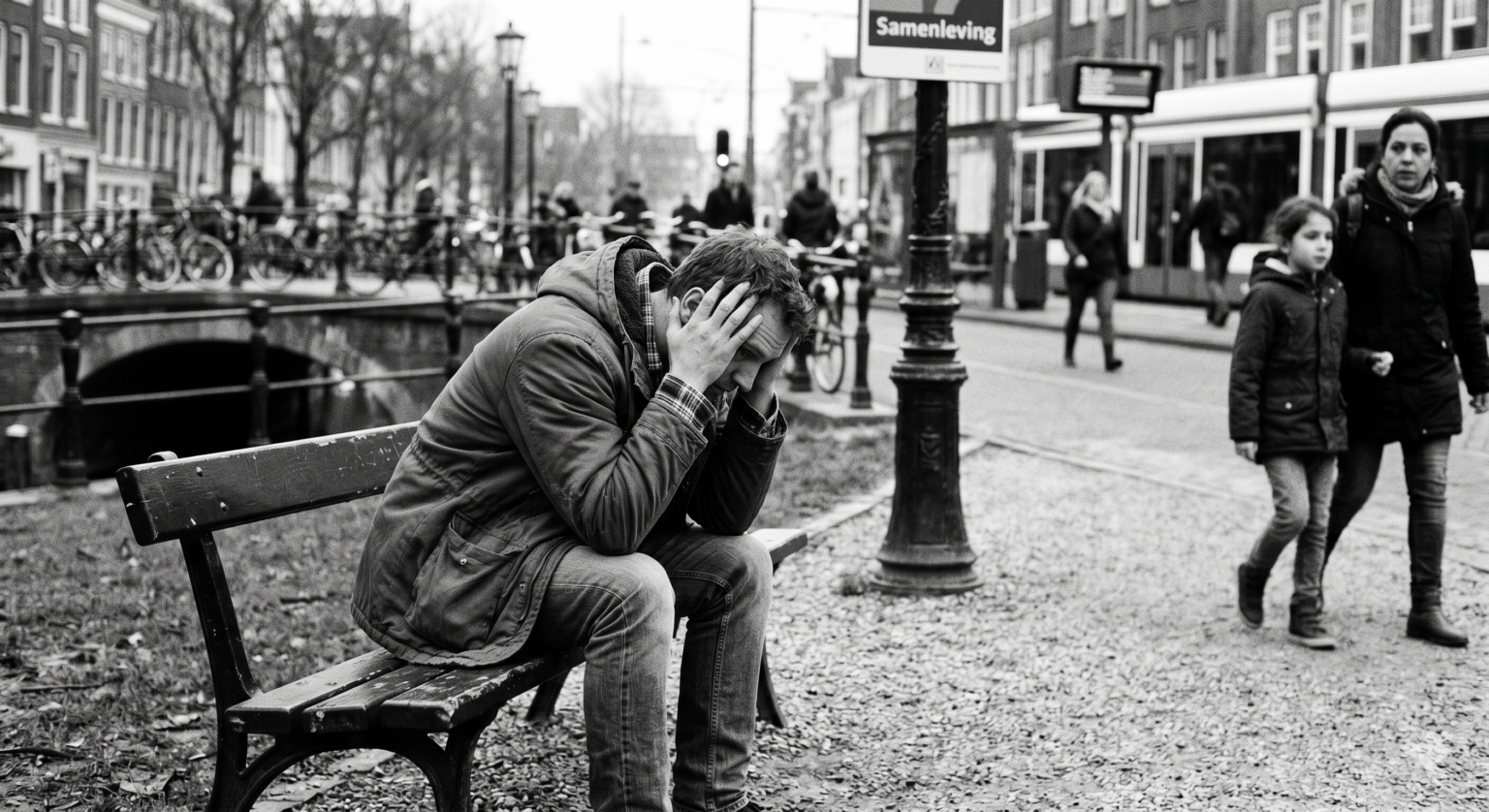
It started with a parking ticket he never paid. Not out of rebellion, but out of a kind of laconic forgetfulness. Nick thought it was merely an insignificant piece of paper, but in the gears of society, his identity changed irrevocably. Nick, the helpful neighbor, slowly dissolved, making way for File Number 88-B.
The Slide
Nick genuinely doesn’t understand it. In his own perception, he is still the man who helped lift Mrs. De Wit’s heavy grocery bags last year. That he subsequently smashed a window at a temp agency in a fit of blind frustration because they didn’t renew his contract, he sees as an understandable human emotion. To the bartender, he simply calls it a moment of release. However, while Nick sits at the bar waiting for a nod of recognition, the bartender looks the other way. After all, those around him do not see his frustration, but read the cold newspaper headlines about increasing vandalism in the neighborhood. Exclusion creeps into his life like a cold draft under the door. Invitations to the annual neighborhood barbecue suddenly stop coming, and people who used to wave now hastily cross the street when they see him approaching. Nick perceives this as an unjustified attack and, annoyed, wonders why everyone is suddenly acting so rudely, since, in his eyes, he has not really harmed anyone. At the same time, he runs into an institutional wall elsewhere. The bank freezes his accounts due to the accumulated fines, and the housing association sends a final warning. When Nick desperately screams at a teller that he is trying to resolve the situation, society hears not a cry for help, but merely a threat from an unpredictable individual.
When he is finally arrested for petty theft, committed out of sheer necessity to be able to eat, Nick feels like the ultimate victim. He does not understand why no one reaches out to him and why the world is treating him so harshly. While society defines him as a criminal who deserves retribution, Nick sees a world that has unjustly spat him out. The bridge between his inner world and our laws has completely collapsed.
The Hard Trut
Our first reflex is often simple and focused on retribution. We want someone to suffer for the nuisance he causes. But when we simply lock Nick up, we do not change anything about his fundamental incomprehension. He comes out of the cell with even more resentment, even more astonishment at his “unjust” treatment, and a rift with society that has only deepened. Punishment isolates the person, but it does not heal the underlying societal wound. If we want someone like Nick to truly realize the impact of his behavior, we must stop building walls. We must force him to look in a mirror held by the people he has actually hurt. A New Way Instead of allowing Nick to serve his sentence passively in a cold cell, where he can cling to his own sense of righteousness, Restorative Justice raises a fundamentally different question. It is not about which law has been broken, but about exactly who has been hurt and what is needed to repair that damage. Where traditional law pits the state against the perpetrator, restorative justice brings the perpetrator directly into confrontation with the victim and local residents.
This method compels an active attitude. Instead of paying an anonymous fine or serving time, Nick sits at the table with the owner of the employment agency and the neighbors who feel unsafe in their own street because of his behavior. It is at that moment that his defensive attitude of “I didn’t do anything anyway” falls away. He can no longer look away when he sees the genuine fear in the eyes of Mrs. De Wit, the woman he previously helped.
This is absolutely not the easy way out. It is far harder for an offender to face the human consequences of his actions straight in the eye and actively take responsibility for restoration than to stare aimlessly at a prison wall. Restorative justice, however, offers the unique opportunity not only to repair a broken window but also to restore the lost connection with the community. It transforms a criminal back into a human being who understands why he is part of the whole. Let us therefore choose a system that not only punishes but also helps heal, so that someone like Nick can start building again instead of tearing down.
Frequently Asked Questions
16 questions
Nick is portrayed as an ordinary helpful neighbor whose troubles begin with an unpaid parking ticket due to forgetfulness rather than rebellion. This leads to his identity shifting from a person to 'File Number 88-B' as fines accumulate and society starts excluding him. His minor frustrations, like smashing a window, escalate his isolation.
The invisible wall refers to the growing societal and institutional barriers that separate Nick from his community and support systems. It manifests through frozen bank accounts, stopped invitations, and people avoiding him, while Nick remains unaware of how others perceive him. This rift deepens his incomprehension of his treatment.
Nick sees his behaviors, such as the window incident or petty theft, as understandable human reactions or necessities, maintaining his self-image as a helpful person. Society, however, labels him a criminal based on headlines and records, ignoring his personal frustrations. This creates a collapsed bridge between his inner world and external laws.
These institutions enforce rules rigidly by freezing accounts due to fines and issuing warnings, treating Nick as a threat when he expresses desperation. Their actions reinforce his exclusion without addressing underlying issues. The article shows this as part of the institutional wall that isolates him further.
Punishment isolates the individual without resolving their fundamental incomprehension of harm caused, often increasing resentment and deepening societal rifts. Nick would emerge with more astonishment at his 'unjust' treatment rather than insight. It addresses symptoms but not the underlying wound.
Restorative justice shifts focus from which law was broken to who has been hurt and what is needed to repair the damage. It brings the perpetrator face-to-face with victims and community members instead of pitting the state against the offender. This compels active responsibility rather than passive suffering of a sentence.
Traditional systems keep the offender passive in a cell, allowing them to cling to self-righteousness, while restorative justice forces direct confrontation with those affected, like neighbors and victims. It replaces anonymous fines with personal accountability at a table with real people. The goal is healing connections rather than isolation.
Nick would sit with the employment agency owner and neighbors who feel unsafe due to his actions, facing genuine fear in eyes like those of Mrs. De Wit. This moment dismantles his defensive attitude of 'I didn’t do anything anyway.' It requires acknowledging human consequences directly.
No, the article explicitly states it is far harder, as facing victims' emotions and taking active responsibility demands more than staring at a prison wall. It challenges the misconception that it is lenient by emphasizing emotional and relational demands. True repair involves both windows and lost community ties.
It can transform a criminal back into a human being who understands their place in the community and actively repairs connections. Beyond fixing physical damage, it heals societal wounds and encourages building rather than tearing down. The system aims to help someone like Nick reintegrate instead of recurring exclusion.
Invitations to events like the neighborhood barbecue stop, and former acquaintances cross the street to avoid him. The bartender ignores him, reflecting community reading of crime headlines over his personal frustrations. This cold draft of rejection reinforces his sense of unjust attack.
Nick believes he has not really harmed anyone and views his actions as minor or justified, failing to see how others interpret them as vandalism or threats. He wonders why people act rudely without recognizing the accumulated fines and incidents shaping their view. This gap fuels his victim mentality.
It asks exactly who has been hurt and what is needed to repair that specific damage, rather than focusing solely on legal violations. This brings victims and residents into the process directly with the perpetrator. The approach emphasizes human consequences and active restoration.
His defensive attitude falls away when confronted with real fear in her eyes, despite previously helping her with groceries. This direct human encounter prevents looking away and compels genuine understanding. It turns abstract rules into personal accountability.
The article references cold newspaper headlines about increasing vandalism in the neighborhood but provides no specific numbers or statistics. It uses this to illustrate how public perception overrides individual context. Broader data on exclusion or recidivism is not detailed.
It urges choosing a system that punishes but also heals, enabling people like Nick to rebuild connections and contribute positively. Restorative justice is positioned as a way to restore lost community ties rather than deepen rifts through isolation. The goal is prevention of further tearing down through understanding.
Generated by AI to give you complete answers about this topic.
* **Services:** AI clones (voice/video), real-time 3D avatar implementation, custom software development, the Yvonta News Platform, and **trade**.
* **Input Data:** Audio, video, or images provided by the client for AI processing.
#### 2. Delivery and acceptance of the service
* **2.1. Best effort:** AI services, the Yvonta News Platform, and trade services are provided on a "best effort" basis. Technical artifacts, minor deviations in likeness, fluctuations in automated content aggregation, or market data latency are inherent to the technology and do not constitute a defect.
* **2.2. Acceptance period:** Custom software and 3D models are deemed accepted if the client does not report specific bugs in writing within 7 days of delivery.
* **2.3. Third-party dependency:** Yvonta frequently utilizes third-party API providers (e.g., AI engines, cloud hosting, news feeds, financial exchange data). Yvonta is not liable for service interruptions, execution failures, or data accuracy issues caused by these third parties.
#### 3. Intellectual property & ethical use
* **3.1. Ownership:** Yvonta retains all rights to its proprietary code, training methods, and base 3D models. The client receives a license for the final result.
* **3.2. Right of likeness:** The client guarantees that they possess the rights to the voice/face being cloned. Yvonta is not obliged to verify these rights but may request proof.
* **3.3. Termination due to misuse:** Yvonta reserves the right to terminate any agreement immediately and without refund if the client uses the services for:
* Generating deepfakes without consent.
* Illegal, hateful, or pornographic content.
* Impersonation for fraudulent purposes.
* Spreading verified misinformation or unauthorized scraping via the News Platform.
* **3.4. Compliance Responsibility:** The Client warrants that their use of the Yvonta News Platform and trade services complies with applicable media laws, financial regulations, copyright regulations, and privacy rules (e.g., GDPR).
#### 4. Liability (The "Shield" clauses)
* **4.1. Financial limit:** Yvonta’s total liability is strictly limited to the amount paid by the Client for the relevant project.
* **4.2. No indirect damages:** Yvonta is in no event liable for loss of profit, loss of data, or consequential damages (e.g., if the Client’s client cancels a contract due to a bug in Yvonta’s software, a failure in the News Platform feed, or financial losses incurred through trade).
* **4.3. Indemnification:** The Client indemnifies Yvonta against all legal costs and damages arising from third-party claims regarding the Input Data, the content published via the News Platform, financial activities conducted via trade, or the Client’s use of the AI output.
* **4.4. Content and Market Disclaimer:** Yvonta acts as the host and provider of the Yvonta News Platform and trade services. The Client is solely responsible for the compliance of published content with local laws and the financial risk associated with trading activities. Yvonta is not liable for damages arising from content accuracy, the legal status of aggregated/generated news, or investment results.
* **4.5. Duty of Human Oversight:** The Client is responsible for maintaining "human-in-the-loop" oversight for all AI-generated content and financial trading parameters before execution or public release. Failure to perform such oversight relieves Yvonta of liability for damages resulting from incorrect information or financial loss.
#### 5. Payments & Maintenance
* **5.1. Payment terms:** Net 14 days from the invoice date, unless stated otherwise.
* **5.2. Suspension:** In the event of overdue payment, Yvonta may remotely block access to the software, the News Platform, trade services, or AI services until the outstanding amount has been paid.
#### 6. Privacy (GDPR)
* **6.1. Biometric data:** The Client acknowledges that AI clones involve the processing of biometric data. The Client is the "Data Controller" and Yvonta is the "Data Processor."
* **6.2. Deletion:** Yvonta deletes the raw input data after completion of the training process, unless agreed otherwise for maintenance purposes.
#### 7. Law and jurisdiction
* **7.1. Governing law:** These terms are governed by Dutch law.
* **7.2. Court:** Any disputes shall be settled exclusively by the competent court in Zwolle, the Netherlands.
Leave a Reply